Robust regression (RLM)
Ordinary least squares minimizes squared residuals, so a handful of gross
outliers can dominate the fit. Robust linear models replace the squared loss
with a bounded influence function (an M-estimator) that downweights observations
with large residuals. Solow's Rlm supports
several norms; here we use Huber's T.
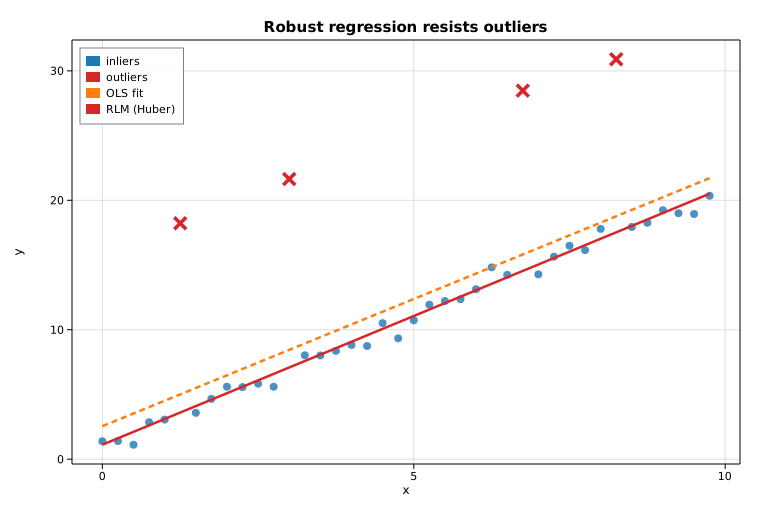
This example contaminates clean linear data with four large vertical outliers and contrasts OLS with the robust fit.
Code
#![allow(unused)]
fn main() {
use ndarray::{Array1, Array2};
use solow_core::tools::{add_constant, HasConstant};
use solow_regression::LinearModel;
use solow_robust::norms::HuberT;
use solow_robust::Rlm;

let n = 40usize;
// Clean data y = 1 + 2 x + noise, then four points get +14 added.
let x = Array2::from_shape_vec((n, 1), x_raw.clone()).unwrap();
let y = Array1::from(y_vec.clone());
let design = add_constant(&x, true, HasConstant::Add).unwrap();

let ols = LinearModel::ols(y.clone(), design.clone()).unwrap().fit().unwrap();
let rlm = Rlm::new(y.clone(), design.clone(), HuberT::default())
    .unwrap().fit().unwrap();
}
RlmResults exposes params, bse, tvalues, pvalues, the robust scale
estimate, the IRLS weights, and convergence info.
Printed summary
Robust linear model (RLM) with Huber's T norm
True coefficients:  const = 1.000   x = 2.000

                             const           x
OLS params                  2.5459      1.9657
RLM params (Huber)          1.1171      1.9890
RLM std err                 0.2127      0.0375
RLM z-value                 5.2527     52.9831
RLM P>|z|                   0.0000      0.0000

Robust scale estimate: 0.5244   iterations: 15   converged: true
OLS is dragged toward the 4 outliers; RLM stays on the true line.
The OLS intercept is pulled up to 2.55 by the outliers, while the robust
estimate of 1.12 stays near the true value of 1.0. The slope is barely
affected because the outliers are vertical.
Plot
Outliers are marked with crosses. The dashed OLS line is tugged upward; the solid robust line stays on the underlying relationship.