Linear mixed effects (random intercepts)
A random-intercept mixed model fits y = β₀ + β₁x + uₘ + ε, where each group
g shares a single random intercept uₘ ~ N(0, τ²) on top of a common fixed
slope and intercept. This example simulates six groups of eight observations,
fits the model by REML with MixedLm, prints the
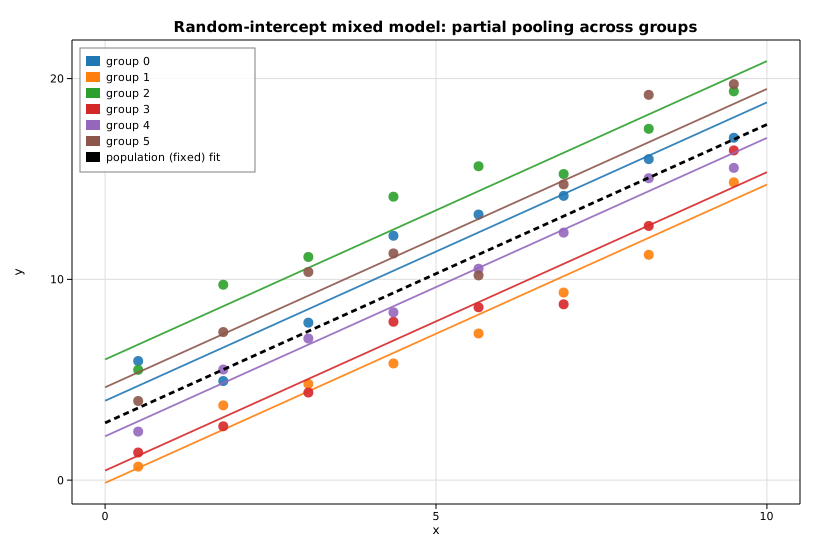
fixed effects and variance components, and draws each group's fitted line. The
group intercepts are shrunk toward the population line — the partial pooling
that distinguishes a mixed model from fitting each group on its own.
Code
#![allow(unused)]
fn main() {
use ndarray::{Array1, Array2};
use solow_mixed::{MixedLm, RemlMethod};
use solow_viz::{Color, Figure, LegendLoc, LineStyle, Marker};

// True model: y = 3 + 1.5 x + u_g + e, with u_g ~ N(0, 2^2), e ~ N(0, 1.1^2).
// Six groups, eight observations each; x spread across [0.5, 9.5].
let n_groups = 6usize;
let per_group = 8usize;
// group_intercepts[g] is drawn once per group and reused within it;
// x_raw / y_raw / group_labels are built from deterministic pseudo-random noise.

let n = x_raw.len();
let mut exog = Array2::<f64>::ones((n, 2)); // intercept column + covariate x
for i in 0..n {
    exog[[i, 1]] = x_raw[i];
}
let endog = Array1::from(y_raw.clone());

// Fit the random-intercept model by REML.
let res = MixedLm::new(endog, exog, &group_labels)
    .unwrap()
    .method(RemlMethod::Reml)
    .fit()
    .unwrap();

let (b0_hat, b1_hat) = (res.fe_params[0], res.fe_params[1]);
}
The random intercepts are the best linear unbiased predictions (BLUPs), which
shrink each group's mean residual toward zero by (nₘ·ψ)/(1 + nₘ·ψ):
#![allow(unused)]
fn main() {
let psi = res.psi;
let blup: Vec<f64> = (0..n_groups)
    .map(|g| {
        let ng = group_count[g] as f64;
        let mean_r = group_mean_resid[g] / ng; // mean of (y - X*beta) over group g
        (ng * psi) / (1.0 + ng * psi) * mean_r
    })
    .collect();
}
Each group is then drawn as a colored scatter with its own fitted line
(intercept = b0_hat + blup[g], shared slope b1_hat), and the dashed black
line shows the population (fixed-effect-only) fit:
#![allow(unused)]
fn main() {
let mut fig = Figure::new(820, 560);
let ax = fig.axes();
ax.set_title("Random-intercept mixed model: partial pooling across groups")
    .set_xlabel("x").set_ylabel("y").set_grid(true);
for g in 0..n_groups {
    let color = Color::cycle(g);
    ax.scatter_full(&xs, &ys, color, 5.0, Marker::Circle, 0.9, Some(&format!("group {g}")));
    let intercept_g = b0_hat + blup[g];
    ax.line(&[0.0, 10.0], &[intercept_g, intercept_g + b1_hat * 10.0],
            color, 1.8, LineStyle::Solid, Marker::None, 0.9, None);
}
ax.line(&[0.0, 10.0], &[b0_hat, b0_hat + b1_hat * 10.0],
        Color::BLACK, 2.8, LineStyle::Dashed, Marker::None, 1.0, Some("population (fixed) fit"));
ax.legend(LegendLoc::UpperLeft);
fig.save_svg("docs/book/src/examples/img/mixed_ranef.svg").unwrap();
}
Printed results
Mixed Linear Model (random intercept), REML
================================================
No. Observations: 48
No. Groups:       6
Group size:       8 (balanced)

Fixed effects:
  const   coef=  2.8520   std err= 1.0529   z=  2.709
  x       coef=  1.4861   std err= 0.0556   z= 26.752

Variance components:
  Group Var (cov_re) = 6.0283
  Residual Var (scale) = 1.2855
  psi = cov_re/scale   = 4.6894
  REML log-likelihood  = -85.1268

Predicted random intercepts (BLUP, shrunk toward 0):
  group 0:  raw mean resid =  1.1312   BLUP u_g =  1.1018
  group 1:  raw mean resid = -3.0704   BLUP u_g = -2.9907
  group 2:  raw mean resid =  3.2425   BLUP u_g =  3.1583
  group 3:  raw mean resid = -2.4382   BLUP u_g = -2.3749
  group 4:  raw mean resid = -0.6845   BLUP u_g = -0.6668
  group 5:  raw mean resid =  1.8195   BLUP u_g =  1.7722
The recovered slope (1.486) and intercept (2.852) sit close to the true
1.5 and 3.0. The group variance (6.03) dominates the residual variance
(1.29), so ψ ≈ 4.69 is large and each group's BLUP is shrunk only slightly
from its raw mean residual — when groups are this well-separated, partial
pooling stays close to the unpooled per-group fit.
Plot