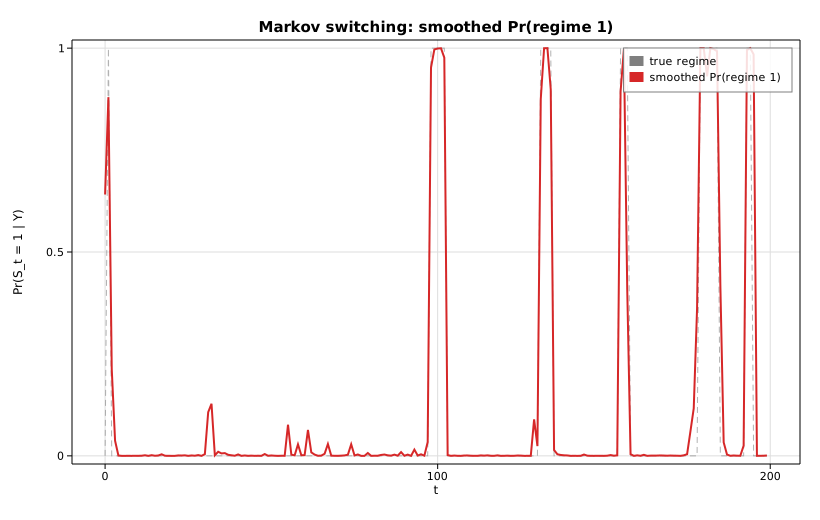
Markov switching regime probabilities
A Markov-switching regression lets the mean (and, optionally, the variance) of a
series jump between a small number of unobserved regimes, with the regime
itself following a hidden first-order Markov chain. This example synthesizes a
series whose mean alternates between a low state and a high state, fits a
2-regime MarkovRegression by maximum
likelihood (the Hamilton filter, polished with the Kim smoother), prints the
fitted transition matrix and per-regime parameters, and plots the smoothed
probability of being in regime 1 over the whole sample — a 0..1 curve that says,
at each time t, how confidently the model places the observation in the
high-mean state given the entire series.
Code
#![allow(unused)]
fn main() {
use ndarray::Array1;
use solow_regime::MarkovRegression;
use solow_viz::{Color, Figure, LegendLoc, LineStyle, Marker};

// A two-state hidden Markov chain drives the mean: regime 0 has mean 0,
// regime 1 has mean 4; both share noise std 1.0. The chain is persistent
// (stays put with probability 0.95), so the series shows clear stretches in
// each state. All noise comes from a deterministic SplitMix64 RNG.
let n = 200usize;
let mu = [0.0f64, 4.0f64];
let mut state = 0usize;
let mut y_vec = Vec::with_capacity(n);
for _ in 0..n {
    if rng.uniform() > 0.95 {
        state = 1 - state;
    }
    y_vec.push(mu[state] + rng.normal());
}
let y = Array1::from(y_vec);

// Fit a 2-regime switching regression (switching intercept and variance).
let model = MarkovRegression::new(y, 2, true).unwrap();
let res = model.fit().unwrap();

println!("log-likelihood : {:.4}", res.llf);
println!("transition     : {:?}", res.transition);
println!("durations      : {:?}", res.expected_durations);
}
The smoothed probability of regime 1 is column 1 of the (nobs, k)
smoothed_marginal_probabilities matrix, plotted against time:
#![allow(unused)]
fn main() {
let t_axis: Vec<f64> = (0..res.nobs).map(|t| t as f64).collect();
let p_regime1: Vec<f64> = (0..res.nobs)
    .map(|t| res.smoothed_marginal_probabilities[[t, 1]])
    .collect();

let mut fig = Figure::new(820, 520);
let ax = fig.axes();
ax.set_title("Markov switching: smoothed Pr(regime 1)")
    .set_xlabel("t").set_ylabel("Pr(S_t = 1 | Y)").set_grid(true);
ax.set_ylim(-0.02, 1.02);
ax.line(&t_axis, &p_regime1, Color::cycle(3), 2.0,
        LineStyle::Solid, Marker::None, 1.0, Some("smoothed Pr(regime 1)"));
ax.legend(LegendLoc::UpperRight);
fig.save_svg("regime.svg").unwrap();
}
Printed output
Markov switching regression (2 regimes)
  converged           : true
  nobs                : 200
  k_params            : 6
  log-likelihood      : -320.5637
  AIC                 : 653.1275
  BIC                 : 672.9174

  estimated parameters:
    p[0->0]      =    0.9634
    p[1->0]      =    0.2629
    const[0]     =    0.1902
    const[1]     =    3.1995
    sigma2[0]    =    1.0201
    sigma2[1]    =    1.2898

  transition matrix P[i<-j] (columns sum to 1):
    [0.9634, 0.2629]
    [0.0366, 0.7371]
  steady-state probs  : [0.8778, 0.1222]
  expected durations  : [27.33, 3.80] periods

  mean smoothed Pr(regime 1) : 0.1175
The estimator recovers two well-separated states: regime 0 has intercept
0.19 and regime 1 has intercept 3.20, close to the true means of 0 and 4
(the regime labels are only identified up to relabelling, so the high-mean state
landed on regime 1). The fitted variances are near the true 1.0. The
persistent low state has an expected duration of about 27 periods versus 3.8
for the high state, and the steady-state distribution spends roughly 88% of
the time in regime 0.
Plot
The smoothed curve snaps close to 0 or 1 over most of the sample — the model is usually confident about which regime generated each observation — with brief ramps at the regime boundaries. The dashed grey line is the true hidden state for comparison.