Bayesian mixed GLM (variational Bayes)
A Bayesian generalized linear mixed model adds Gaussian random effects to a GLM. Here we fit a binomial (logit-link) model with a per-group random intercept,
logit P(yᵢ = 1) = b₀ + b₁ xᵢ + u_group(i), u_g ~ N(0, σ_u²),
using BayesMixedGlm::fit_vb, which maximizes the
evidence lower bound (ELBO) of a mean-field Gaussian variational posterior. This
is deterministic variational Bayes, not MCMC: the fit returns a posterior
mean and posterior standard deviation for every parameter (an approximate
Gaussian posterior), so we summarize the fixed effects as point estimates with
±2 posterior-sd credible bands rather than drawing samples.
The data is synthesized from the generative model above with the gallery's deterministic SplitMix64 RNG (8 groups × 12 observations = 96 rows), so the run is fully reproducible.
Code
#![allow(unused)]
fn main() {
use ndarray::{Array1, Array2};
use solow_bayes::{BayesMixedGlm, Family};
use solow_viz::{Color, Figure, LegendLoc, LineStyle};

// Generative model: logit P(y=1) = -0.4 + 1.3 x + u_g,  u_g ~ N(0, 0.8²).
let (n_groups, per) = (8usize, 12usize);
let n = n_groups * per;
let (true_b0, true_b1, true_sigma_u) = (-0.4_f64, 1.3, 0.8);

let mut rng = common::Rng::new(20240618);
let group_u: Vec<f64> = (0..n_groups).map(|_| true_sigma_u * rng.normal()).collect();

// Fixed-effects design [1, x]; random-effects design = one indicator column
// per group (a random intercept). `ident` ties every group column to a single
// variance component (one shared log-sd parameter).
let mut exog = Array2::<f64>::zeros((n, 2));
let mut exog_vc = Array2::<f64>::zeros((n, n_groups));
let mut endog = Array1::<f64>::zeros(n);
for i in 0..n {
    let g = i / per;
    let xi = -1.5 + 3.0 * (i % per) as f64 / (per as f64 - 1.0);
    let eta = true_b0 + true_b1 * xi + group_u[g];
    let p = 1.0 / (1.0 + (-eta).exp());
    exog[[i, 0]] = 1.0;
    exog[[i, 1]] = xi;
    exog_vc[[i, g]] = 1.0;
    endog[i] = rng.bernoulli(p);
}
let ident = vec![0usize; n_groups];

// Fit by variational Bayes. vcp_p / fe_p are the prior sds for the
// variance-component log-sd and the fixed effects.
let model =
    BayesMixedGlm::new(Family::Binomial, endog, exog, exog_vc, ident, 1.0, 4.0).unwrap();
let res = model.fit_vb(None, None, 100_000, 1e-6).unwrap();

// res.fe_mean / res.fe_sd  -> fixed-effect posterior mean & sd
// res.vcp_mean             -> log-sd of the random intercept (exp -> sigma_u)
// res.vc_mean / res.vc_sd  -> per-group random-intercept posteriors
// res.elbo                 -> maximized ELBO (the variational log-likelihood)
}
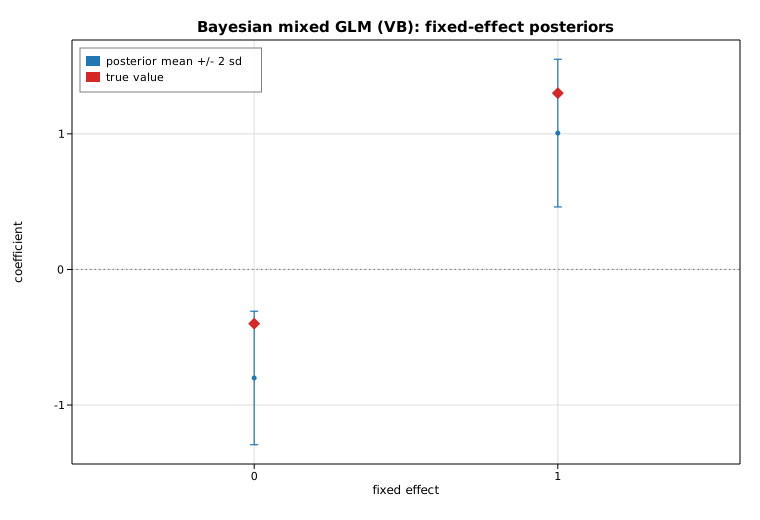
The fixed-effect posteriors are then plotted as points with ±2 posterior-sd credible bands, with the data-generating truth marked for reference:
#![allow(unused)]
fn main() {
let xs = [0.0_f64, 1.0];
let means = [res.fe_mean[0], res.fe_mean[1]];
let err2 = [2.0 * res.fe_sd[0], 2.0 * res.fe_sd[1]];
let truth = [true_b0, true_b1];

let mut fig = Figure::new(760, 520);
let ax = fig.axes();
ax.set_title("Bayesian mixed GLM (VB): fixed-effect posteriors")
    .set_xlabel("fixed effect").set_ylabel("coefficient").set_grid(true);
ax.set_xlim(-0.6, 1.6);
ax.axhline(0.0, Color::GRAY, LineStyle::Dotted);
ax.errorbar(&xs, &means, &err2, Color::cycle(0), Some("posterior mean +/- 2 sd"));
ax.scatter_full(&xs, &truth, Color::RED, 6.0, solow_viz::Marker::Diamond, 1.0, Some("true value"));
ax.legend(LegendLoc::UpperLeft);
fig.save_svg("bayes_posterior.svg").unwrap();
}
Printed results
Bayesian mixed GLM (binomial / logit) by variational Bayes
  observations: 96   groups: 8   per group: 12
  converged: true   iters: 23   |grad|: 2.764e-7   ELBO: -63.481683

Fixed effects (approximate Gaussian posterior):
  name               post. mean     post. sd    post. mean +/- 2 sd
  intercept (b0)       -0.80040      0.24613   -1.29267 .. -0.30814
  slope (b1)            1.00540      0.27225    0.46090 ..  1.54991

Variance component (group random intercept, log-sd):
  vcp posterior mean: -0.02104   posterior sd: 0.24284
  implied sigma_u = exp(vcp_mean): 0.97918   (true 0.800)

Random intercept posterior means by group (vc_mean):
  group  0: post. mean  0.24616  post. sd 0.53770  (true u  0.48418)
  group  1: post. mean -1.05301  post. sd 0.60813  (true u -1.18688)
  group  2: post. mean -0.36203  post. sd 0.56185  (true u -0.80476)
  group  3: post. mean -0.36203  post. sd 0.56185  (true u -0.83760)
  group  4: post. mean -0.36203  post. sd 0.56185  (true u -1.28414)
  group  5: post. mean  0.81912  post. sd 0.53053  (true u  0.23701)
  group  6: post. mean  1.39322  post. sd 0.53873  (true u  0.90634)
  group  7: post. mean -0.36203  post. sd 0.56185  (true u -1.05832)
The 95%-style credible band for the slope (0.461 … 1.550) comfortably covers
the true 1.3, and the band for the intercept (-1.293 … -0.308) covers the
true -0.4; with only 96 binary observations the variational posterior is
appropriately wide. The recovered group-intercept sd, exp(vcp_mean) ≈ 0.979,
is in the right neighborhood of the true 0.8 (a single small sample identifies
a scale parameter only loosely).
Two honest caveats worth noting. First, several groups (2, 3, 4, 7) land on the
identical posterior mean -0.36203: with the same within-group x grid these
groups happened to draw the same 0/1 outcome pattern, so they share sufficient
statistics and the posterior cannot distinguish them — the random-effect means
shrink them all toward the common value. Second, variational Bayes is known to
understate posterior uncertainty relative to full MCMC, so these bands should
be read as the variational approximation's credible intervals, not as exact
posterior intervals.
Plot